Safari with children
It works, and it works better with some honest planning. The constraints are real (minimum ages, attention spans and driving hours), and all three can be designed around.
Is your child old enough?
There is no single answer, but there are useful thresholds. Below about five, a safari is largely for the parents. Long drives, early starts and animals that appear at distance rarely hold a small child, and several good camps will not accept under-sixes at all.
From around six to eight it becomes genuinely rewarding with the right pace. From ten upward children often out-spot the adults and remember the trip for the rest of their lives. Teenagers do extremely well, particularly where walking safaris and photography are available to them.
We will tell you honestly if we think your children are too young for the trip you are describing, and suggest a shape that would work instead.
What we change for families
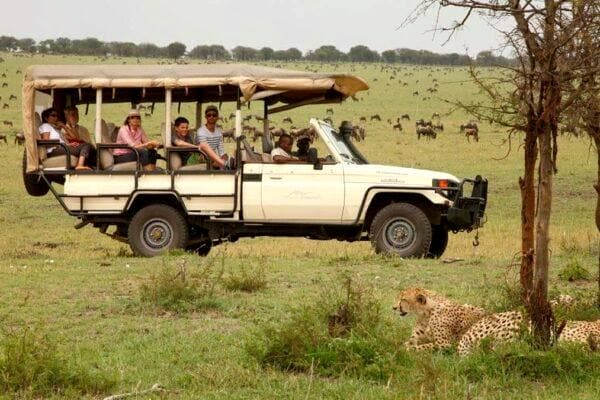
- A private vehicle for your family as standard, so you can return to camp when a child has had enough. A shared vehicle is only used on a group safari you choose.
- Shorter drives and more nights per camp. Two nights minimum, three where possible.
- Camps with pools, which matter more than any other single feature in the middle of the day.
- Family rooms or adjoining tents, which are limited and book out early.
- A guide chosen for being good with children, which is a genuinely different skill from spotting cats.
- Non-driving activities built in: a canopy walkway, a cultural visit, a night drive where permitted.
- Flexible meal times, which most camps handle willingly if asked in advance.
Where to go with children
Tarangire is the best northern-circuit park for families. It is two hours from Arusha rather than eight, the elephant herds in dry season are spectacular and close, and the baobabs give children something to look at between sightings.
Lake Manyara works well for a half day, mainly for the canopy walkway and the enormous baboon troops: animals that behave visibly rather than lying still under a tree.
Ngorongoro is worth one early descent. The crater is dense enough that something is always happening, which is exactly what a child needs.
The Serengeti is best flown to rather than driven with young children, and best given three nights rather than two.
Zanzibar on the end of a safari is the single best decision most families make. It turns an intense week into a holiday.
The honest difficulties
- Early starts. The best game viewing is at dawn and there is no way around it.
- Long transfers between parks, which is why we cut parks rather than nights for families.
- Minimum ages on walking safaris, usually twelve and sometimes fifteen, set by the camps and rangers rather than by us.
- Some premium camps do not accept children at all, which narrows the top end of the market considerably.
- Malaria prophylaxis for children requires a conversation with your doctor well before you travel.
- Single-parent or grandparent travel may need documented consent to enter Tanzania with a child, so check well ahead.
What makes it work
The single biggest factor is not the park or the camp. It is whether the itinerary was built around the children rather than adapted for them afterwards. A family trip with two parks, three nights each, a pool at both, and a guide who explains dung beetles as enthusiastically as lions will beat an ambitious five-park route every time.
The second biggest factor is giving children something to do. A notebook and a species list, their own cheap binoculars, a camera they are allowed to break. Children who are recording the safari engage with it completely differently from children who are being shown it.
Family questions
It depends on the camp rather than on us. Many accept all ages, several set a minimum of six, and some premium camps will not take under-twelves. Walking safaris are usually twelve and up. Tell us your children's ages first and we will only show you places that will have you.
Sometimes, between sightings. That is honest. It is largely solved by shorter drives, a pool in the middle of the day, and a guide who involves them. Children who are given a job on the vehicle rarely get bored.
Yes, with the normal rules: stay in the vehicle unless your guide says otherwise, no leaning out, and follow camp escort rules after dark. Camps in unfenced areas escort guests to tents at night, and that applies particularly to children.
Prophylaxis is recommended and the options for children differ from adults, so this needs a conversation with your doctor several weeks before travel. Repellent, long sleeves at dusk and treated nets do much of the work.
No. Most camps offer reduced child rates and some park fees are lower for children, though the discounts vary widely. Family rooms are usually better value than two doubles.
If the budget allows, yes. A few days on the coast after a safari week is what turns the trip into a holiday, and it is the part children tend to talk about first afterwards.
The practical decisions behind a family trip.