Walking Safaris
Three hours on foot with an armed ranger changes the scale of everything. You stop counting animals and start reading ground.
What it actually is
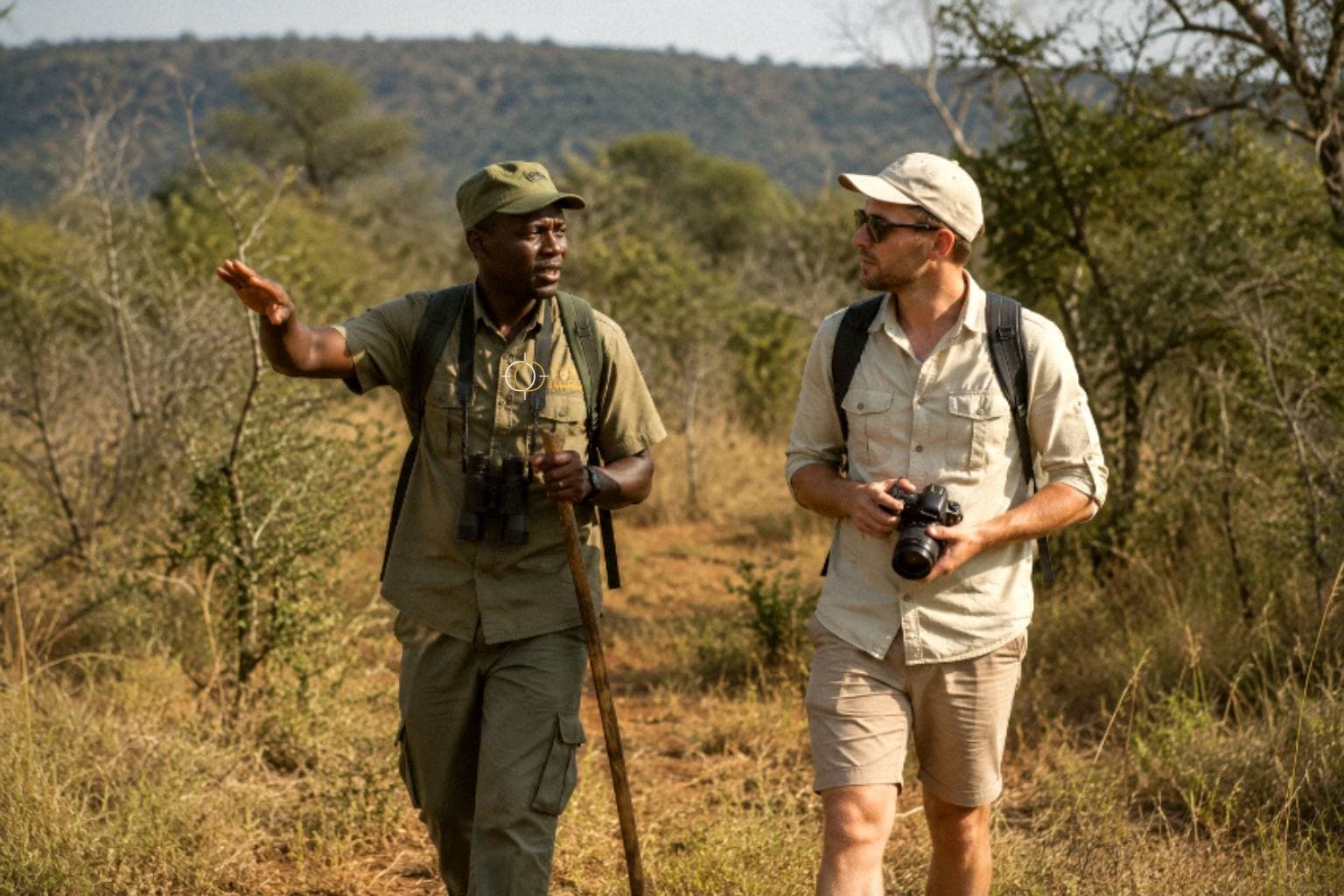
A guided walk, usually at first light, with a professional walking guide and an armed ranger. Groups are small: six people at most, often two or three. You move slowly, in single file, and cover perhaps four kilometres in three hours.
It is not a game drive on foot. You will almost certainly see fewer animals than you would from a vehicle, and that is the point: the subject becomes tracks, dung, bones, termite architecture, medicinal plants, birds, and the sound of what is moving nearby.
Why travellers remember it
In a vehicle you are inside a machine and the animals treat it as one object. On foot you are part of the environment, at the same scale as everything in it, and your attention changes completely. People describe it as the first time the bush felt real rather than televised.
Guides also work differently. A walking guide has to explain the small things, and the good ones are naturalists rather than spotters.
Where it is possible
- Tarangire, in designated areas with a ranger: one of the best options on the northern circuit.
- Private concessions bordering the Serengeti, where park rules do not apply and walking is easier to arrange.
- The Ngorongoro highlands, including Empakaai and Olmoti craters, which are walked rather than driven.
- Ruaha and Nyerere in the south, where walking is a core activity rather than an add-on.
- Not inside the Serengeti National Park itself, where general walking is not permitted.
Practical realities
- Dawn starts, because it is cooler and animals are active. Expect to leave camp at six.
- Neutral clothing, closed shoes and long trousers. Not a fashion rule; you will be walking through thorn.
- Moderate fitness only. It is slow and flat in most areas, but there is no vehicle to return to quickly.
- Most camps set a minimum age around twelve, and some fifteen. We will check before promising anything.
- A separate permit and ranger fee applies in national parks; we build it into the quote rather than surprising you.
How we build it in
One walk is the right number on a short trip, done from a camp with the correct permits so you are not driving an hour to a start point. On journeys of ten days or more we plan two or three, and choose at least one camp specifically because its walking guide is excellent.
Questions travellers actually ask
It is a controlled activity with a licensed armed ranger and strict protocols on distance, wind and single file. Incidents are very rare, but this is genuine wilderness and you follow instructions rather than wander.
Sometimes. Elephant, giraffe and buffalo at a respectful distance are common. Approaching predators on foot is not the objective and guides will actively avoid it.
Usually from twelve, occasionally fifteen, depending on the camp and the ranger. For younger families we look at private concessions with more flexibility.
Reasonably. Three hours of slow flat walking in warm air. If mobility is a concern, tell us and we will find a shorter option or a highland walk with an easier surface.
Ask about this journey
Send us a few details and a person on the team will reply personally, not a template.
The parks where this works best, and the journeys with room for it.